RMC Plant Manufacturer in India – Cost, Capacity & Types
RMC stands for Ready Mix Concrete. An RMC plant is a controlled production facility where cement, aggregates, water, and admixtures are accurately proportioned and mixed to produce concrete for delivery to construction sites.
RMC plants are used for projects that require consistent concrete quality and planned production, including highways, metro rail, commercial buildings, residential developments, and other infrastructure projects across India.
The right RMC plant depends on factors such as required production capacity, project duration, site conditions, plant configuration, and concrete demand. This guide covers RMC plant types, capacity selection, setup requirements, cost factors, and the key considerations when choosing an RMC plant manufacturer in India.
RMC Batching Plant Manufacturers in India
Choosing an RMC plant manufacturer is an important decision because plant configuration, batching accuracy, automation, service support, and long-term parts availability directly affect production and operating efficiency.
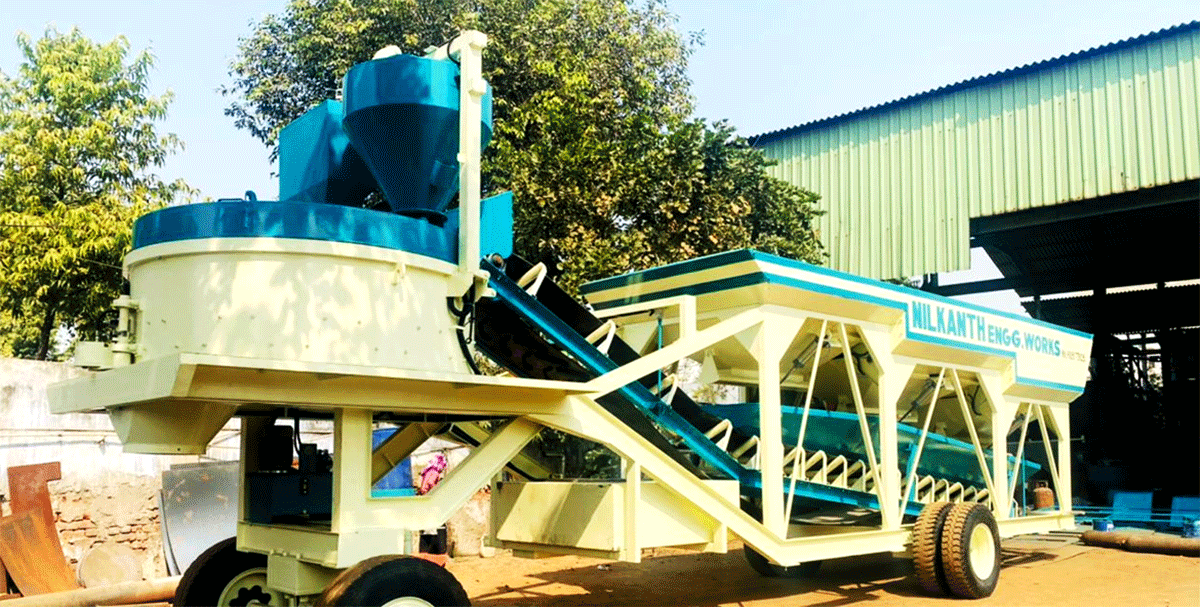
Nilkanth Engineering Works manufactures RMC and concrete batching plants for different production requirements, with
mobile, compact, and stationary configurations available across a range of capacities. Plant layouts can be configured according to project requirements, available space, production demand, and site conditions.
Our RMC plant systems include aggregate storage and feeding, cement storage, weighing and dosing systems, mixing equipment, and automated control systems. Depending on the plant configuration, the equipment can be selected for projects requiring flexible deployment, space-efficient installation, or continuous high-volume production.
With more than 43 years of manufacturing experience and 1,250+ machines supplied, Nilkanth provides plant manufacturing, installation support, and after-sales service for customers across India and export markets.
Key Components of an RMC Plant
Aggregate Bins – Store and feed different sizes of aggregates into the batching system.
Cement Silo – Stores cement and, where required, fly ash for controlled feeding into the plant.
Weighing System – Accurately measures aggregates, cement, water, and admixtures according to the selected mix design.
Mixer Unit – Mixes the measured materials uniformly to produce consistent concrete.
Water & Admixture System – Controls the required quantity of water and chemical admixtures during batching.
Control Panel & Automation System – Manages batching sequences, material dosing, recipes, and plant operation.
What is RMC Plant?
RMC (Ready Mix Concrete) plant is a centralized facility where cement, aggregates, water, and admixtures are stored, weighed, and mixed in controlled proportions to produce ready-mix concrete.
The plant uses automated batching and mixing systems to maintain consistency in material measurement and concrete production. Once the concrete is mixed, it is typically discharged into transit mixer trucks for transportation to the construction site.
An RMC plant can be configured according to production capacity, project requirements, available space, and the required method of material handling. Common configurations include stationary, compact, and mobile batching plants.
The main stages of RMC production include:
1. Aggregate feeding and storage
2. Cement and supplementary material storage
3. Accurate weighing of materials
4. Water and admixture dosing
5. Mixing
6. Discharge into transit mixers
7. Transportation to the construction site
Mobile vs Compact vs Stationary RMC Plant – Which Is Right for Your Project?
Parameter
Mobile RMC Plant
Compact RMC Plant
Stationary RMC Plant
Project Type
Short-term, remote or multiple-location projects
Projects with limited space and moderate production needs
Long-term projects at a fixed location
Installation
Quick installation and relocation
Compact installation with efficient site utilisation
More extensive installation and site preparation
Production
Suitable for flexible, moderate production
Suitable for space-efficient production
Suitable for continuous, higher-volume production
Space Requirement
Lower
Lower than conventional stationary setups
Requires more planned space
Relocation
Easy to relocate
Limited relocation depending on configuration
Not designed for frequent relocation
Best For
Road projects, remote sites and temporary works
Space-constrained sites and compact RMC operations
Large commercial and infrastructure projects
Choose a mobile plant when flexibility, quick relocation and deployment across different sites are important.
Choose a compact plant when available space is limited but you still need a dedicated batching solution.
Choose a stationary plant when you have a long-term project with consistent, high-volume concrete demand.
Select RMC plant capacity according to your required concrete output, project duration, available space, and expected production demand.
Capacity
Suitable For
Indicative Output* (8 Hours)
Key Advantage
Best Suited For
30 m³/hr
Small contractors and local projects
Up to 240 m³/day
Lower capacity and easier operation
Small to medium concrete requirements
60 m³/hr
Residential and commercial projects
Up to 480 m³/day
Balanced production capacity
Regular and medium-to-high concrete demand
90 m³/hr
Large infrastructure projects
Up to 720 m³/day
Higher production capacity
Continuous and high-volume concrete production
120 m³/hr
Major infrastructure and mega projects
Up to 960 m³/day
Very high production capacity
High-volume and continuous concrete requirements
Indicative output represents the rated hourly capacity multiplied by an 8-hour operating period. Actual production may vary depending on mix cycle time, material loading, truck availability, plant utilisation, site conditions, and operating requirements.
RMC Plant Silo Capacity
Cement silos are used to store cement and fly ash in bulk and provide controlled feeding to the batching plant. The required silo capacity depends on plant capacity, concrete production demand, material consumption, delivery frequency, and available site space. Large RMC plants may use multiple silos to support continuous production.
RMC Plant Price in India – Cost Factors & Setup Investment
The cost of an RMC plant in India depends on the plant capacity, configuration, level of automation, equipment selection, and project requirements. The price of the batching plant is only one part of the total investment required to establish an RMC operation.
Key factors that influence RMC plant price and overall setup cost include:
Plant Capacity – Higher-capacity plants generally require larger batching, storage, weighing, and mixing systems.
Plant Configuration – Mobile, compact, and stationary RMC plants have different equipment, installation, and site requirements.
Automation Level – The control system, weighing accuracy, automation, and monitoring requirements can affect the overall plant cost.
Cement Silos & Storage – Silo capacity and the number of silos depend on cement consumption, production requirements, and material delivery frequency.
Installation & Civil Works – Foundations, structural work, electrical connections, site preparation, and installation contribute to the setup investment.
Transit Mixers & Concrete Delivery – The required fleet depends on production capacity, delivery distance, traffic conditions, and project requirements.
Land & Site Development – Land cost, access roads, drainage, raw-material storage, and vehicle movement areas vary by location.
Working Capital – An RMC operation also requires working capital for cement, aggregates, admixtures, fuel, labour, maintenance, and other operating expenses.
For this reason, the final RMC plant price should be evaluated according to the required capacity, plant configuration, equipment specifications, and site conditions rather than using a single price for every project.
Nilkanth Engineering Works manufactures RMC and concrete batching plants in mobile, compact, and stationary configurations. Plant specifications can be selected according to production requirements, available space, and project conditions.
For detailed batching plant pricing and configuration options, see:
India’s construction and infrastructure sector is growing rapidly, creating huge demand for ready mix concrete.
High demand in metro cities and tier-2 cities
Government infrastructure projects driving growth
Shift from manual mixing to RMC
Operational Advantages of an RMC Plant
Controlled batching and mix consistency
Automated weighing and dosing
Higher production efficiency
Reduced manual material handling
Better production planning
Reduced on-site storage requirements
Consistent concrete supply for scheduled pours
Ability to scale capacity according to demand
Disadvantages of RMC Plant:
RMC plants offer controlled and efficient concrete production, but they also require careful planning, investment, and logistics.
Initial Investment – Setting up an RMC plant requires investment in batching equipment, silos, civil works, utilities, and related infrastructure.
Transportation & Delivery – Concrete must be delivered within the required time, making transit mixer availability, delivery distance, and route planning important.
Space & Site Requirements – The plant requires suitable space for equipment, aggregate storage, silos, vehicle movement, and supporting infrastructure.
Maintenance & Operations – Regular maintenance, skilled operators, and timely availability of spare parts are important for consistent plant operation.
Demand & Capacity Utilisation – Plant economics depend on maintaining sufficient production demand and utilising the available capacity effectively.
Site & Regulatory Requirements – Installation may require appropriate land, utilities, environmental permissions, and local approvals depending on the location and project.
Why Choose Nilkanth for Your RMC Plant?
Nilkanth Engineering Works provides complete RMC plant solutions:
43+ years of manufacturing experience
1,250+ machines supplied
700+ customers — ONLY if this figure is verified internally
Custom plant design as per project requirements
After-sales support & spare availability
FAQ’s
An RMC plant (Ready Mix Concrete plant) is a facility where concrete is produced using cement, aggregates, water, and admixtures in controlled conditions. The ready mix concrete is then transported to construction sites using transit mixers, ensuring better quality, consistency, and faster construction compared to manual mixing.
To start an RMC plant business, you need:
Select suitable land (1–2 acres)
Choose plant capacity (30–120 m³/hr)
Purchase batching plant and transit mixers
Obtain licenses (pollution control, local authority)
Set up utilities (water, power, access roads)
The setup cost of a Ready-Mix Concrete (RMC) plant in India is usually between ₹2.60 Crores to ₹3.30 Crores.
This investment includes:
Plant machinery with silos, concrete pump, and DG set – around ₹1.2 Crores
Transit mixers (3 trucks) – about ₹1.5 Crores (or ₹60 Lakhs if you buy second-hand trucks)
Civil work and utilities – approx. ₹30 Lakhs
Licensing & miscellaneous – approx. ₹20 Lakhs
The actual cost can vary depending on plant capacity, number of silos, and mixer requirements.
The land requirement for an RMC plant depends on plant capacity, layout, aggregate storage, silo arrangement, transit mixer movement, and site requirements. A typical setup may require around 1–2 acres, but the actual requirement should be determined from the plant layout and project conditions.
The batching plant and silos
Storage for cement and aggregates
Transit mixer parking
Water tanks and admixture tanks
Office, utilities, and staff facilities
The average profit margin in RMC business ranges from 15% to 25%. Higher margins are possible in high-demand areas with large infrastructure projects and efficient plant utilization.
Concrete batching plants are available in multiple capacities:
Mini plant: 10–20 m³/hr
Small plant: 30 m³/hr
Medium plant: 60 m³/hr
Large plant: 90–120 m³/hr
The right capacity depends on daily concrete demand and project scale.
Yes, RMC plants are profitable when capacity utilization is maintained above 70%. Profit margins typically range between 15% to 25%, depending on demand, location, and operational efficiency.
Requirements of RMC plant refers to the equipment and things that are installed in this machinery that decides “how concrete is produced in the RMC plants”.
Key personnel
Concrete mix design
Production, and testing facilities
control on the quality of concrete ingredients
Final product
Delivery
Control and maintenance of process control equipment
There are three types of RMC plants available in the market at the RMC plant manufacturer such as mobile, compact, and stationary concrete batching plant. You can consider it as per your requirement or capacity.
A 30 m³/hr RMC plant is commonly used for small to medium projects. The plant cost usually falls between ₹45 lakh and ₹65 lakh. Including installation, civil work, and approvals, the total setup cost can reach ₹55 lakh to ₹80 lakh. The above prices are indicative market ranges. Actual costs may vary based on plant design, automation level, location, transportation, and local regulatory requirements.
There are three major types of RMC plants mobile, compact and stationary concrete batching plants.
Key factors affecting RMC plant cost include:
Plant capacity (30–120 m³/hr)
Automation level
Number of transit mixers
Cement silo size
Location and logistics
Raw material availability
These factors significantly impact total investment.
Mobile RMC plant: Portable, quick setup, ideal for short-term projects
Stationary RMC plant: Fixed installation, high capacity, best for long-term projects
The choice depends on project duration and production requirements.
The best RMC plant manufacturer offers high-quality machinery, automation, and strong after-sales support. Nilkanth Engineering Works is known for providing reliable and customized RMC plant solutions across India.
An RMC plant usually requires 1–2 acres of land depending on the plant capacity. The area is used for the batching plant, cement silo, raw material storage, transit mixer movement, and other operations.
Tags:
rmc plant price
rmc plant cost
rmc plant capacity
rmc plant setup
small rmc plant
ready mix concrete plant
ready mix concrete plant cost
ready mix concrete plant setup cost
rmc plant manufacturer in ahmedabad
rmc plant manufacturer in gujarat
rmc plant manufacturer in india
ready mix concrete plant manufacturers
rmc batching plant manufacturers in india
rmc plant manufacturer,rmc plant setup cost
Ready to invest in an RMC plant?
Contact us today to learn more about RMC plant price and how our customized solutions can help you meet your construction goals efficiently. Let us provide you with a detailed quote based on your specific requirements and help you choose the best RMC plant for your project.